

Qualcomm has officially unveiled its next-generation flagship mobile platforms, the Snapdragon 8 Elite Gen 6 and the higher-end Snapdragon 8 Elite Extreme Gen 6, marking the company’s move to 2nm smartphone chipsets.
Announced at the latest Snapdragon Summit, both platforms feature the next-generation Qualcomm Oryon CPU, Adreno GPU and Hexagon NPU, with upgrades focused on performance, power efficiency, on-device AI, gaming and mobile photography.
Two flagship tiers
Unlike previous generations, Qualcomm is splitting its flagship platform into two tiers this time.
The Snapdragon 8 Elite Gen 6 will serve as the mainstream flagship platform, while the Snapdragon 8 Elite Extreme Gen 6 is positioned for smartphones targeting the highest levels of performance.
One of the biggest highlights is the new Oryon CPU, which can reach 5GHz on the Extreme model. Qualcomm describes it as the first mobile CPU to hit the 5GHz mark, while its new Oryon Flex Cache architecture is designed to keep large workloads closer to the CPU cores.
Qualcomm says the standard Snapdragon 8 Elite Gen 6 delivers a 10% CPU performance improvement and 37% better CPU power efficiency compared with the previous generation.
Faster graphics with AI-assisted rendering
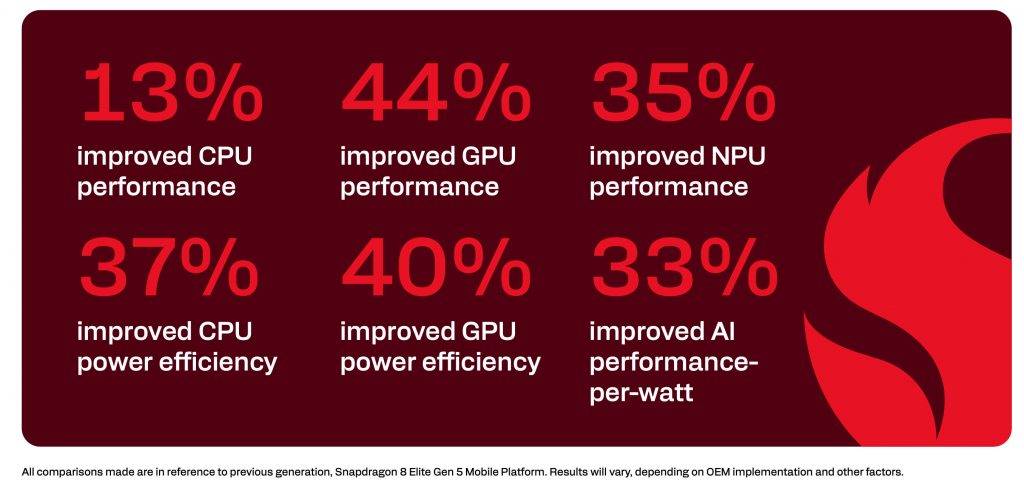
Graphics performance is also getting a substantial upgrade. The new Adreno GPU delivers higher performance while improving efficiency, with the Extreme model adding Adreno Matrix Cores and 18MB of Adreno High Performance Memory.
The platform also introduces Adreno Neural Fusion, which combines AI Super Resolution and Frame Generation into the graphics pipeline. Qualcomm says the technology can improve image quality while reducing rendering workloads and power consumption.
This could become increasingly important as Android games continue adopting more advanced graphics features such as high frame rates, ray tracing and console-style rendering.
From AI assistants to Agentic AI

Beyond traditional CPU and GPU upgrades, Qualcomm is putting a major emphasis on Agentic AI.
The new Hexagon NPU is designed for generative and multimodal AI workloads, with a 50% larger shared memory that helps keep AI models closer to the processor. Qualcomm says the architecture is designed to run Mixture-of-Experts models directly on the device, allowing AI agents to handle more complex tasks without relying entirely on cloud processing.
The idea is to move smartphone AI beyond simply answering questions, summarising content or generating images. Instead, AI agents could understand context, work across different apps and carry out multiple steps on a user’s behalf, with the necessary permissions.
AI also enhances photography and video
The new Snapdragon platforms also continue to combine ISP and AI processing for mobile photography.
The chipset can analyse subjects, scenes, lighting and other elements during capture, allowing smartphones to apply more sophisticated computational photography and video processing in real time.

For flagship phones increasingly using high-resolution sensors and advanced telephoto camera systems, the capabilities of the ISP and AI hardware are becoming just as important as the camera sensors and lenses themselves.
Next-generation Android flagships are coming
With the Snapdragon 8 Elite Gen 6 series now official, Android manufacturers including Xiaomi, HONOR, OPPO, OnePlus and realme are expected to introduce upcoming flagship devices powered by the new platforms.
Qualcomm’s decision to offer both the standard Snapdragon 8 Elite Gen 6 and the higher-end Extreme model also means flagship phones from the same generation could have noticeably different performance tiers depending on which chipset they use.
The first smartphones powered by the new Snapdragon platforms are expected to arrive in the coming weeks, setting the stage for the next wave of Android flagships.
For more info, stay tuned to MyMobileTrend.