
Google has officially launched a music generation feature for its Gemini AI assistant, powered by Google DeepMind’s latest Lyria 3 model. Currently in beta, the update brings AI music creation to Gemini’s more than 750 million monthly active users, marking a significant step toward making AI-generated music accessible to everyday users rather than just creators or developers.
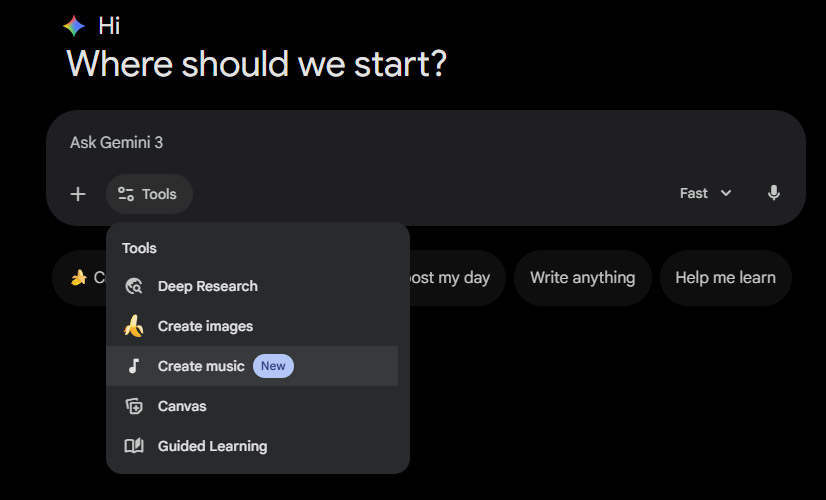
To use the feature, users can navigate to the “Music” option within Gemini’s Tools menu and describe a style, mood, personal memory, or even an inside joke. Gemini will then generate a 30-second original track — either with lyrics or as a pure instrumental — along with an AI-generated album cover produced by Google’s Nano Banana model. Beyond text prompts, users can also upload photos or videos, and Gemini will compose a song that matches the emotional tone of the media. Completed tracks can be downloaded directly or shared via a link.
Compared to its predecessors, Lyria 3 delivers meaningful improvements across several areas. Lyrics are now generated automatically based on the user’s prompt, removing the need to write them manually. The model also produces audio at a 48kHz sampling rate, yielding higher fidelity sound with richer musical layering — building compositions organically rather than stitching together looped segments, which gives tracks a more coherent feel from start to finish. Users can further refine their results by adjusting elements such as genre, vocals, and tempo.
On the copyright and content safety front, Google says its training process was conducted with licensing agreements in mind. If a user name-drops a specific artist in their prompt, Gemini will not directly imitate that artist but will instead treat the reference as a stylistic cue, producing an original track with a similar mood or atmosphere. The platform also applies content filters that cross-check generated music against existing works, and users can report outputs they suspect may infringe on copyrighted material. All tracks are embedded with a SynthID digital watermark — inaudible to the human ear but detectable by software even after compression or editing. The AI detection capability has also been extended to audio, meaning users can upload any audio file and ask Gemini whether it was generated by Google AI.
The feature launched first on desktop, with mobile support rolling out over the coming days. Alongside the Gemini update, YouTube’s Dream Track feature has also been upgraded to run on
Lyria 3 and expanded from the United States to creators worldwide, allowing YouTubers to generate AI background music for their Shorts.
Music generation is now available to users aged 18 and above globally, with support for English, German, Spanish, French, Hindi, Japanese, Korean, and Portuguese, with more languages planned.
Google AI Plus, Pro, and Ultra subscribers will have access to higher usage quotas.
The launch comes amid broader industry debate around AI music — while platforms like YouTube and Spotify are in active discussions with record labels over AI music monetisation, several AI companies continue to face legal action from the music industry over the use of copyrighted material in model training.
For more tech news, stay tuned to MyMobileTrend